
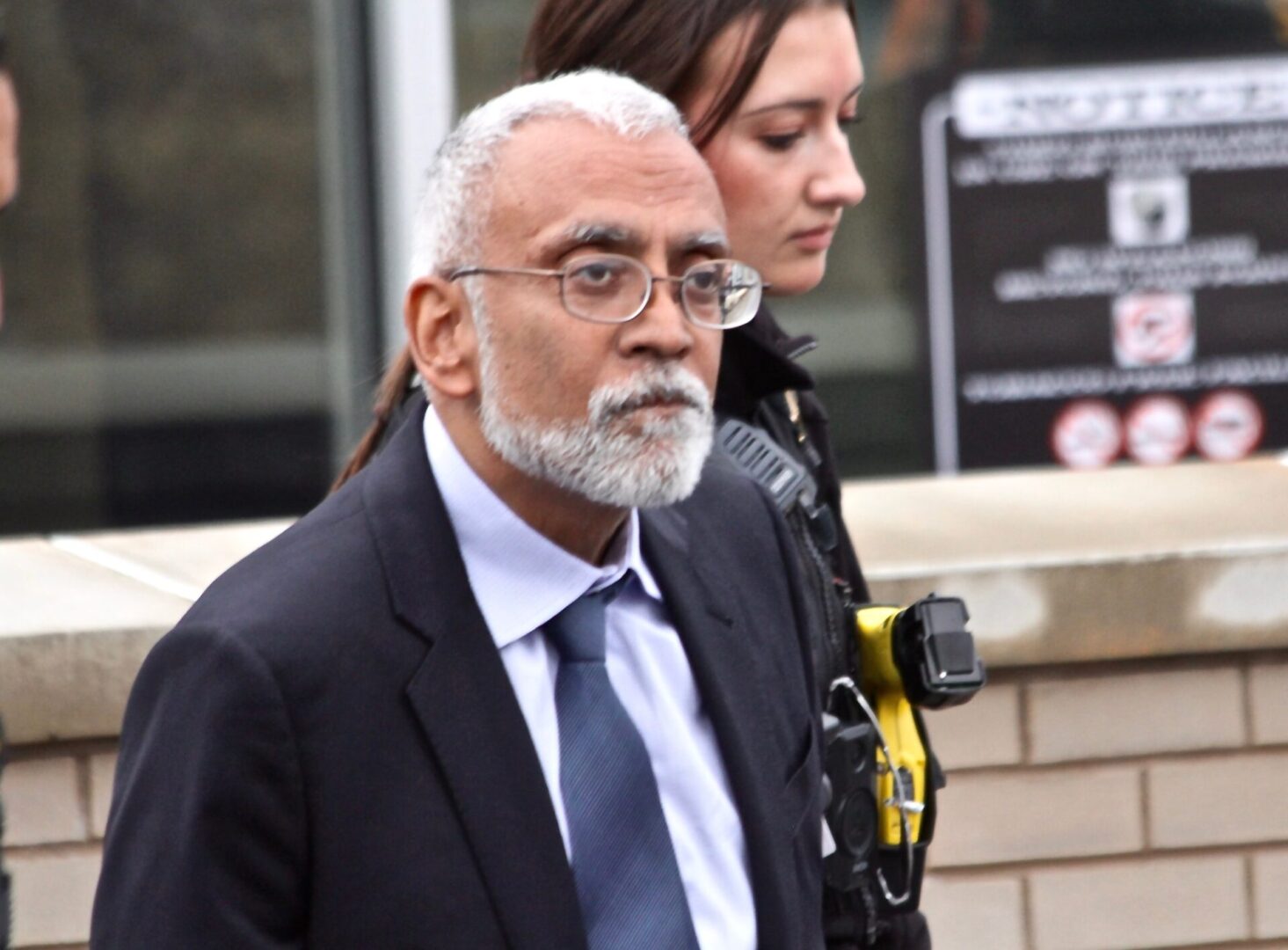
A State College man who spent more than 40 years in prison before his murder conviction was overturned will remain in federal custody as his immigration case proceeds following a judge’s ruling on Tuesday morning.
During a 25-minute hearing held via video conferencing, immigration Judge Tamar Wilson denied Subramanyam “Subu” Vedam‘s request to be released on bond from the Moshannon Valley ICE Processing Center in Clearfield County.
Wilson ruled that she did not have jurisdiction to grant bond because of Vedam’s 1984 conviction on drug charges, felonies that she said make him subject to mandatory detention.
After being convicted in 1983 for the murder of Thomas Kinser near State College, Vedam resolved a separate case by entering a no contest plea to four counts of selling LSD when he was 19-years-old. The drug conviction resulted in a 1999 deportation order and is the basis for Immigration and Customs Enforcement’s efforts to remove him from the country since his release from state prison in October.
Wilson also concluded that Vedam cannot establish that he does not pose a danger to the community, despite his record as a model inmate during his four decades at Huntingdon state prison.
“The [drug] conviction alone is very serious, counsel, and he’s been convicted of an aggravated felony,” Wilson told Vedam’s immigration attorney, Ava Benach. “… He’s been imprisoned, so I don’t have a period of time to show that your client is not a danger to the community. The fact that he’s been a model prisoner does not suggest that out in the general public he’s going to be safe. I cannot allow somebody who’s been convicted of an aggravated felony out on bond. I’m not going to do that.
Vedam, who was born in India and has lived nearly his entire life in the United States, will appeal to the U.S. Board of Immigration Appeals through his attorneys later on Tuesday, a spokesperson for his family said in a statement.
Wilson heard the request for bond two weeks after the U.S. Justice Department’s Board of Immigration Appeals vacated Vedam’s deportation order and returned his case to immigration court, finding that it “presents an exceptional situation.”
“We’re disappointed that the judge denied Subu’s request for release from ICE lock-up after he has already served 43 years in a maximum-security prison for a crime he didn’t commit,” Saraswathi Vedam, Subu Vedam’s sister, said. “The recent Board of Appeals ruling in Subu’s case nullified the deportation order pending against him, which means the government has not proven valid grounds to remove him from the country. Under these circumstances, and coupled with the fact that Subu compiled an exemplary record of good conduct during more than four decades of wrongful imprisonment, we had hoped the court would agree that Subu did not need to remain in ICE detention while waiting for an immigration hearing.”
Benach contended that had Vedam been incarcerated solely on the drug charges, and not the murder conviction for which he was exonerated in 2025, he would have been released by 1992. Under rules that were in place for people released from prison prior to 1997, she argued, Vedam would not have been subject to mandatory detention.
Wilson called the argument “creative” but ultimately ruled she did not have jurisdiction to release Vedam.
Benach also argued that Vedam poses no danger to the community.
“We are talking about offenses that occurred over 40 years ago,” Benach said. “He served 40 years in prison for a crime he did not commit. In his time in prison, he earned three degrees, had an exemplary record, not a single demerit, … he created programs to help inmates and has a sterling record of over 40 years in prison. He is a 64-year-old man, and these are crimes that occurred when he was a 20-year-old man.”
She noted that the Centre County District Attorney Bernie Cantorna said he would not have dropped the murder charge after the conviction was vacated if Vedam posed a danger. Centre County First District Attorney Joshua Andrews was available during the hearing on Tuesday to answer questions from the court, Benach said, though he was not called on by Wilson. State College Mayor Ezra Nanes was also willing to speak on Vedam’s behalf, Benach added.
The drug convictions were for “delivery of LSD on a very small scale” 45 years ago, Benach said.
“This is not importing tons of cocaine,” she said. “This is small town work.”
Vedam also is not a flight risk, Benach said, as he has an extensive network of family and friends to support him and an offer to live with his niece.
Wilson, however, agreed with Adam DeBernardis, attorney for the Department of Homeland Security’s Office of the Principal Legal Advisor, who said that though Vedam’s murder conviction was overturned, the convictions that remain are for drug trafficking, and that he has had no opportunity to show he would not be a danger.
“I appreciate everything counsel has mentioned but it has been hard, if not impossible, for [Vedam] to commit any sort of additional crimes because he has been in custody since the ’80s,” DeBernardis said, “And, if he would not have been serving his sentence for the for the murder, he would already have been removed based on his prior removal order. So, even if you do find there is jurisdiction, we would still say he is a risk and a danger to society.”
Vedam has imprisoned since 1982, when he was arrested for the murder of his friend Kinser.
Kinser had last been seen by family on Dec. 14, 1980, when he borrowed a van to drive his friend and fellow 19-year-old State College area resident Vedam to Lewistown to buy LSD. Vedam said Kinser dropped him off in State College when they returned and he did not know what happened to him after that.
After hikers discovered Kinser’s body on Sept. 19, 1981 in a sinkhole at Bear Meadows in Harris Township, prosecutors said Vedam used a .25 caliber handgun to shoot his friend in the head. Vedam’s conviction was based in part on his purchase of a .25 caliber gun, which he said he did not acquire until after Kinser’s death, and a shell casing of the same caliber found under Kinser’s remains. A murder weapon was never found, and casings of different calibers were also discovered in the area.
He was convicted in 1983 and again at a 1988 retrial, but in recent years,
Vedam’s post-conviction attorneys uncovered evidence not presented at either trial, including documents they say showed that bullet hole in Kinser’s skull was too small to have been made by a .25.
In August, a Centre County judge ruled that the evidence could have swayed the jury to find Vedam not guilty at trial and overturned the conviction. Two months later, Centre County District Attorney Bernie Cantorna announced that he would drop the charges against Vedam because, with key evidence and witnesses no longer available, it would be nearly impossible to prosecute the decades-old case.
He was set to be released from Huntingdon state prison on Oct. 3, but was taken into ICE custody that same day.
Since then, a federal court issued an emergency stay of deportation after ICE transported Vedam from the Moshannon Valley facility to Texas in preparation for his removal. He was then returned to Clearfield County, where he remains, and in early February the BIA vacated the deportation order for the case to be returned to immigration court.
“Subu is nothing if not resilient, and we’re resolved to emulate the example he sets for us by focusing on the next step in his fight for freedom,” Saraswathi Vedam said. “We continue to believe his immigration case is strong and look forward to the day we can be together again.”



